01FROM GLIDER TO QUESTION
A real beginning.
A better question.
Not a story of simply wishing harder. Three moments in the Wright brothers’ work show how an idea became something they could investigate.
What still needed solving?
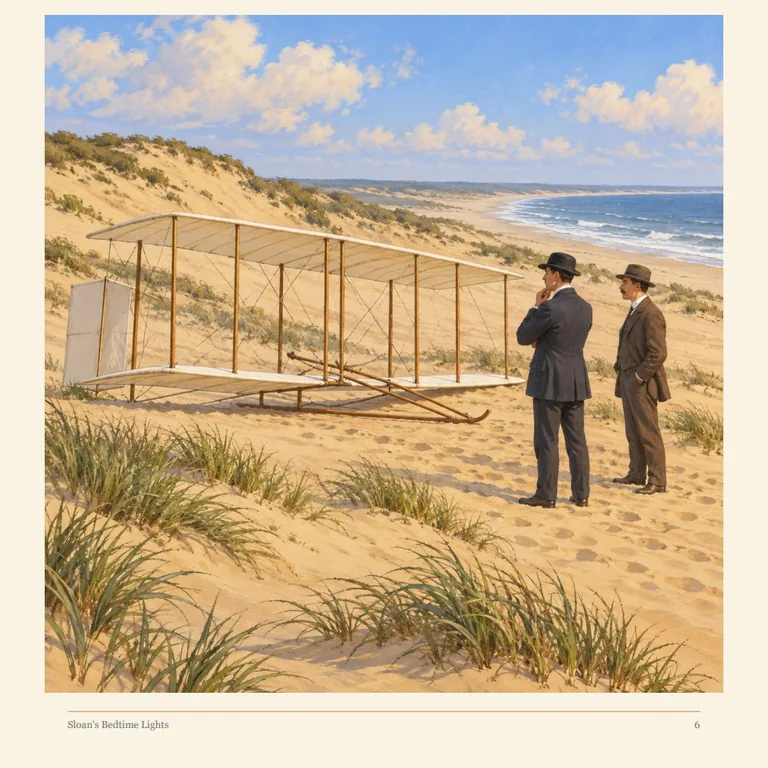
People had already flown in balloons and gliders. The Wright brothers wanted to work on a different problem: powering and controlling an airplane. They studied what others had learned and tested gliders of their own.
In the NPS account, their 1900 glider produced less lift than expected. Observing that difference gave them something specific to investigate, rather than a reason to repeat the same design unchanged.
Book: physical pp. 5–9 · NPS: “Method and Inspiration” and “1900”
A smaller thing to measure.
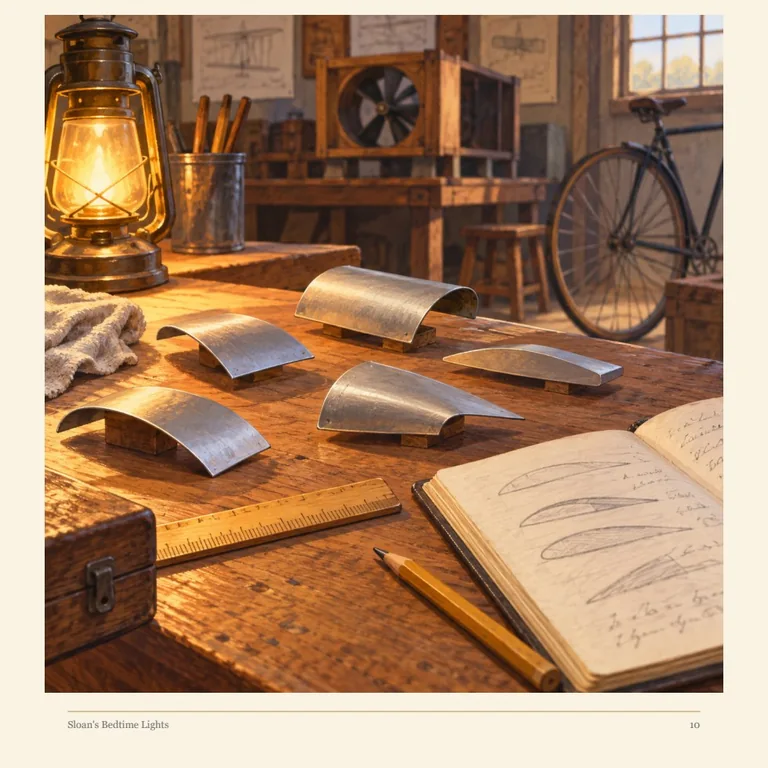
The brothers built a wind tunnel: a passage where moving air could pass over small models. Comparing wing shapes helped them gather measurements and reconsider the information behind their designs.
The NPS account places this work after the difficulties of 1901. In the book, the wind tunnel is a turning point from an expectation to a comparison: look at what happened, then change the design.
Book: physical pp. 11–13 · NPS: “1901” and “1902”
Twelve seconds, after years of work.
They revised their designs using what they learned. On December 17, 1903, near Kitty Hawk, North Carolina, Orville’s first powered flight lasted twelve seconds.
The book does not reduce this history to determination alone. Its account includes questions, measurements, changes and years of work. The useful connection to our activity is careful comparison, not a promise that a particular fold will fly.
Book: physical pp. 13–17 · NPS: “1902” and “1903”
HERE, THE BOOK CHANGES REGISTER
And now, we imagine.
The illustration on physical page 18 opens the modern reflection. Physical page 19 explicitly asks us to imagine a paper airplane resting on a table, and says this is not another event from the brothers’ lives.
The girl, Mom and Cali belong to that present-day reflection. Our paper-fold activity belongs here, too: it is an original companion activity, not a reconstruction of a Wright experiment.
Bring one small question to the tableRead the sources.
Historical summaries above draw on the book’s physical pages 5–17 and the source identified on physical page 37. Illustrations are interpretive, not photographs or exact reconstructions.
National Park Service: The Road to the First Flight (opens in a new tab)Complete original book PDF, including the source note (opens in a new tab)